
Author Q&A
A few answers to questions I've been asked...

What made you write a spy thriller?
I love spy novels, both as a reader and as a writer.
As MI5 will tell you, anyone is a potential spy, and I like to think anyone could be a spy writer, as long as you’re a good enough cynic and liar, and you live in a morally grey area (I reckon Derby qualifies) and you’re prepared to betray… no, forget that.
But seriously, this is a genre, or a collection of genres, or a meeting of genres – a brush contact, maybe – in which, yes, a fair few authors have had some connection to the secret world, but many others haven’t (or not that they know of, at any rate). There’s a sense that if you have a real feel for liars and secret identities – and let’s face it, many of us lead high-stakes secret lives of one kind or another – you could write one yourself, in the same way as you don’t have to be a murderer or a murder detective to write compelling crime.
I like that inclusivity, ironic though it may be for a world of suspicious loners. Whereas with straight military thrillers, for example, there’s the prevailing wisdom that if “You weren’t there, man!”, then you can’t or shouldn’t pretend to know what it was like. Which is fair enough, I suppose. When I read a detail-rich tale of special forces, I want the author to be sharing some actual expert knowledge of that world and not just making it all up. Whereas with a spy story, sure, sometimes it’s nice to feel you’re getting some of that arcane lore, but it’s by no means the whole point of it. Often the making it all up is the point of it. How much can they really tell you anyway, and can they be trusted? Added to which, spy stories and spy characters have the potential to be more intricately crafted, which appeals to me as a reader and as a writer. Whereas I don’t think we’d necessarily want an unreliable narrator, for example, in the ex-special forces stories...
Having said that, when you’re writing about the WWII period, as I have done, insider knowledge of modern operations and methods isn’t so necessary and if over-applied can even detract from the historical realism – in a similar fashion to those recent movies where actors playing WWI or WWII infantrymen have obviously been advised to use their sights while patrolling, or to employ modern trigger discipline. Someone my age grew up surrounded by adults who’d fought in WWII or experienced the Home Front and that was an invaluable resource of period-accurate experience.
There’s another part to the answer too. I don’t just read spy novels. I love all kinds of fiction, from sci-fi to literary fiction, if done well. And – how can I put this? – in my personal, limited experience, those last two categories have maintained high standards over the years, whereas certain areas of thrillers and spy fiction have perhaps tailed off a bit in terms of overall quality. Either the writing is a little flat and one-paced, or else the plot is shapeless or predictable. And when I read or give up reading one of those, it makes me yearn for the books that so inspired me when I was younger – either because they were better written, like Anthony Price for example, or because the plots were so damn lively and gripping, like Alistair MacLean. Or my personal favourite in the spy/action thriller genre, Peter O’Donnell and Modesty Blaise.
And when I start yearning for a book that I can’t find, that’s when I want to write it.
You have two main characters – a man and a woman. Is that pairing inspired by Modesty Blaise and Willie Garvin?
Definitely, in some respects. Although in many ways, that’s where the similarity ends. I may have pinched the idea of a male and female action duo – and perhaps some peripheral aspects of Modesty and Willie’s relationship – but this is a very different kind of entanglement and a very different kind of story. For a start, it’s set in a real historical-political context at the very end of WWII.
My thinking boiled down to this: the world of the SOE field agents is a literary gift; here are hugely courageous secret agents involved in intrigue, betrayal and even shoot-em-up action – and some of them are women, some of them are men. Obviously I’m making sweeping generalisations but in a marketplace in which, all too often, it seems that men read male authors and men’s stories, and women read female authors and women’s stories, it offers a tantalising middle ground between the “Dad” action thriller and the more female-oriented Home Front drama.
But what seems to dominate in this historical niche (despite notable exceptions, Sebastian Faulks for instance), is fiction based on the well-documented exploits of the female F-Section agents, written by women, marketed to women. And if that’s a fair observation, I think it’s a shame that male and female readers aren’t invited to read the same stories, the way they do in other areas of spy fiction, or crime, or many other genres.
So with Peter O’Donnell’s example as my inspiration, I decided that I wouldn’t be pigeon-holed like that. He had shown that a male author could write a great female character in the spy/action genre. And he also showed how, as a man, one can easily sidestep the whole “men shouldn’t write women” minefield and justify doing it: simply by writing two main characters, one male, one female. (As it happens, of course, O’Donnell also wrote women very successfully in the historical romance genre, under a female pseudonym). So I thought I could learn from what he had created with Modesty and Willie, whilst also being mindful of how times have changed, particularly as regards the “male gaze”, which is certainly present in O’Donnell’s work, even if he also transcends it marvellously. (And that’s not just me talking; Modesty has always had and continues to have female fans, including those who see her as a kind of progenitor for strong female characters from Buffy to Lisbeth Salander.)
The other thing I knew I had to steer clear of was France and SOE’s F-Section. As I’ve said, those stories are being told and marketed and I didn’t want to re-tread well-worn footsteps, nor to step on any toes. So even though I had a personal connection through my screenwriter uncle, who told me about working with Vera Atkins and Odette Sansom on Carve Her Name With Pride, I had to search for pastures new...
By the way, in the first draft of CHASING MERCURY Book Three, I’ve just included a sly throwaway tribute to O’Donnell that I may or may not keep in there. Mila uses a strip of cotton from her dress and a familiar thumb-tying trick to disable an adversary: During her training a formidable lady had shown her how to make use of the most modest means and methods to fulfil their mission of setting Europe ablaze.
What made you set THE BORODINO SACRIFICE in Czechoslovakia?
It’s not only set in Czechoslovakia. The story visits more recognisable WWII spy settings like Paris and Berlin. But yes, the bulk of the action takes place in the newly liberated Czechoslovakia.
I’d always had a curiosity about Czechoslovakia, because it was part of family folklore. Through my uncle, we knew the film director John Guillermin, and when he was shooting his big-budget Hollywood war picture The Bridge at Remagen, in which the freedom-hungry Czechoslovakia of the “Prague Spring” was standing in for Nazi Germany – closely watched by the KGB of course – his wife, the actress and writer Maureen Connell, managed to throw off her tail and send me a package from Prague, postmarked the very day the Russian tanks rolled in. (It was a child’s coat and I was only three-and-a-half, but let’s not spoil an intriguing story…)
Then, on a trip to the Czech Republic after the Velvet Revolution, I became intrigued myself. Touring various towns in what had been the southwestern Sudetenland, I was struck by the presence of conflicting war memorials, with the older ones, erected soon after the war, paying tribute to the Soviet forces that had supposedly liberated the town and, right next to them – often less official and more heartfelt, with flowers and ribbons left by the townsfolk – other memorials thanking the troops who had really liberated the town, namely the Americans. These memorials had only recently gone up, because it was only recently that the collective memory had been permitted again.
This drove me to the history books, and I soon found conflicting accounts there as well. Despite the key role that the Sudetenland played in the run-up to war, many of the broader histories overlook the complexity of the final advance through here, when as far as the Americans were concerned they were in the Third Reich, but actually they were also in the former Czechoslovakia, all the way to Pilsen. Many of the histories then trot out the same line: that once the war was over, the US forces withdrew to the German-Czech border. But which version of that border do they mean? Sometimes you get the impression they haven’t thought about it. And in fact, when you turn to individual accounts and unit histories, the US Army didn’t entirely pull out from Czech soil until just before Christmas 1945. It’s not always a subject that people want to talk about, either, because it means dealing with other things that were happening in the region, like the mass abuse and expulsions of Sudeten Germans after the war, which is one of those uncomfortable truths that doesn’t fit the conventional narrative and is often swept under the carpet. The first thing that drew me to this story is that it takes place in that neglected gap between war and peace, when everything was in flux.
So there’s a whole period, and region, that is murky, ill-defined and still contested by east and west, as it was then – fertile ground for spy fiction if you’re looking to do something different.
Throw in the uranium mines at Jachymov and you’re well on your way!
How many books are there in the CHASING MERCURY series? Do I have to read them in order?
One at the moment and probably three in total. And not necessarily.
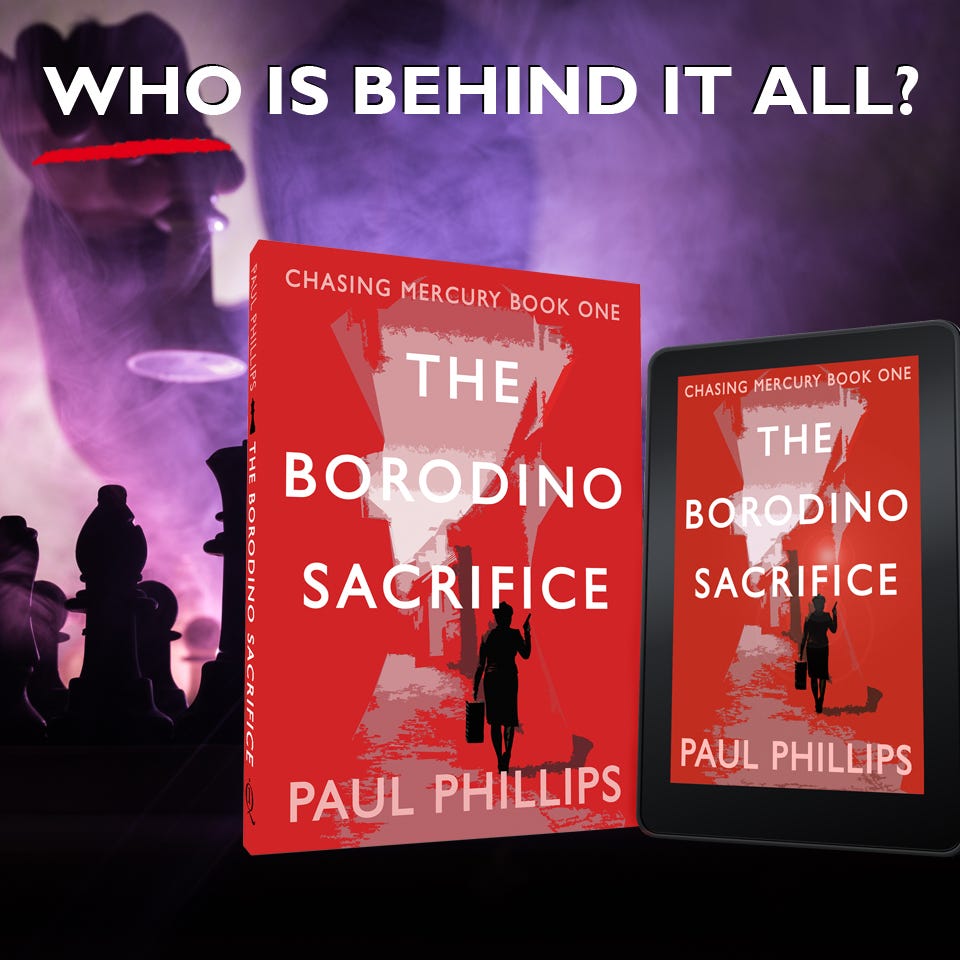
SPOILER ALERT(ish): the first book in the series, THE BORODINO SACRIFICE, ends in such a way that you could stop there and call it a proper ending, or decide to read on. Up to you.
The second book, THE HERRENHAUS FORFEIT, which has been written but is yet to be published (watch this space!), ends in a similar manner – there’s a resolution, but that doesn’t mean the story can’t and won’t continue. The difference here is that the book makes reference to certain events from Book One. However, it is self-contained and does explain the backstory, so you could start the series here and backtrack later if you felt like it.
The third book, tentatively titled THE SAFEHAVEN COMPLEX, is looking like it might be the final instalment. However, I’m still writing it and things might very well change, especially if there is interest in continuing Mila and Bradley’s adventures. Again, in theory you could start here if you wanted to (but you really can’t, because I need to find the time to finish it!)